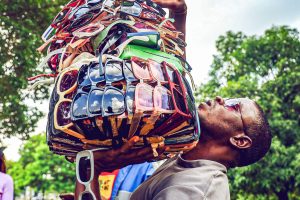
What a Trader in Accra’s Makola Market Taught Me About the Wealth Africa Refuses to Trade
By Musila Muoki
Makola is not in Lomé or Ouagadougou
I was hunting for a stall in Makola, Accra’s sprawling, chaotic, and magnificent open-air market, when I stopped to ask a trader for directions, thanks to my mother’s appetite for Kente cloth-making material. He looked at me, paused, and said one word, “Farasé”. Then again. Then a third time, more emphatically before I understood that he wasn’t naming a place but rather telling me, in the most shorthand available to him in that instance that French was the only language he spoke and understood.
Turning that moment over time and again, it was strange that a man in Accra only spoke French because Makola is not in Lome, Abidjan, or Ouagadougou. The legendary market sits in the heart of an Anglophone, pidgin-speaking city. However, the trader’s calculus was the live possibility that the next customer walking towards him would speak the language of trade, money for goods.
This perhaps is the most honest data point that I collected on my expedition in the Gold Coast. This told me that Ghana’s markets are already more integrated with Francophone West Africa neighbors more than our formal trade statistics, our visa regimes, or our national imaginations tend to admit.
The Market that Ignores the Map
The Makola market spectacle has never respected the borders drawn around it. Ghana is wedged between Francophone Côte d’Ivoire, Burkina Faso, and Togo, and for generations traders, porters, and itinerant sellers have moved through Accra’s markets the way water moves through a poorly built dam, around obstacles. Africa forgets that trade ought not require a treaty but only that profits from moving goods and people exceed the cost of moving them. There is therefore a great chance of a Burkinabe shea butter wholesaler, Ivorian moving cocoa by products, and a Togolese trader selling max print in Makola market as it should be in all markets across the continent.
This would underscore a quite joke underneath the protectionist policies on trade among Africans across the continent as informal traders appear to have been practicing the AfCFTA for decades. The African Continental Free Trade Area Agreement (AfCFTA) seeks to create a single market for goods and services in Africa to deepen its economic integration while creating a liberalized market.
“Every unnecessary border checkpoint, every unratified free-movement protocol, every hour lost to a visa queue is wealth that was created and then confiscated before it could compound.”
A study of ECOWAS between 2019 and 2023 on the Abidjan-Lagos corridor running through Ghana, Togo, Benin, and Nigeria showed an estimate of $22.8 million in informal trade on the stretch alone where women accounted for 74% of the volume. Extrapolating this across every land border on the continent highlights that this economy dwarfs by a great margin what customs officials record in format cross-border trade. An estimate of the Afreximbank shows that informal trade across the continent functions as a sources of income for roughly 43% of Africa’s population. Moreover, women make up an estimated 70% of informal cross-border traders creating the backbone of a market economy that most African governments refuse to see.
The Numbers Formal Trade Won’t Hide
The uncomfortable arithmetic is that Intra-African trade, the trade actually measured, taxed, and celebrated in communiques has stagnated between 15 to 21 percent of the total global trade. This is compared with intra-Asian trade at around 60 percent and intra-European trade that nears 70%. Clearly, Africa sells more of itself to the rest of the world than it sells to itself, which is a policy choice, repeated over fifty-four times across the continent, than a natural law of geography.
This gap, however, does not exist because Africans don’t want to trade with fellow Africans. Rather, the trade policy framework has made it easier, cheaper, and safer for Ghanaian cocoa exporters to reach Rotterdam than to Ouagadougou. The Afreximbank has estimated that intra-African trade is climbing to about $230 billion in the 2026 outlook report while lifting the share to by about 10% in 2026 to about 16%. While this is genuine progress, it is measured against a baseline that is embarrassingly low.
Comparatively, the world bank has estimated that the full implementation of the AfCFTA could unlock as much as $450 billion in regional income while lifting 30 million African people out of poverty by 2035. This is far from an abstract number as it represents a thousand Makola markets that are yet to be allowed to fully exist. It is therefore necessary to recognize that some of the machinery designed for that future is already turning. The Pan-African Payment and Settlement System (PAPSS) for instance is now live. PAPSS is expected to reduce foreign-exchange costs of Intra-African transactions by 20 to 30%. This presents a direct assault on a currency friction that has long made trading with a neighbor in the continent more expensive that when trading with others beyond. But payment rails mean little if people and goods still cannot cross the land between them.
Borders are a Tax on Human Enterprise
Often, the case for free-markets stops from being ideological and turns arithmetic at the mention of border inefficiencies. Every visa requirement, every discretionary customs delay, and every informal “facilitation fee” is a tax on the Togolese cloth seller or the Burkinabe shea butter trade. These sellers often have no lobbyist or embassy to call compared to large corporations. The 1979 protocol on Free Movement of Persons, Residence, and Establishment by ECOWAS gives the bloc a near perfect score visa-free reciprocity among its members, something the continent is attempting to replicate through the AfCFTA.

The continent has continued to struggle on this aspect despite the existence of a similar protocol under the AfCFTA. Moreover, the Protocol on Free Movement of Persons of the African Union adopted in 2028 has been ratified by only four member states eight years later even as the Africa Visa Openness Index shows visa-free travel across the continent rising only from 20 percent in 2016 to 28 percent in 2025.
Ideally, three-quarters of intra-African journeys still require some form of permission from a government that has no legitimate security interest in denying it. We have built, with great ceremony, a continental free trade area for goods while leaving the humans who carry those goods. Traders, truckers, and the market women who mover 70% of the region’s informal commerce more often than not depend on the whims of immigration officers.
What Makola Already Knows
A pan-Africanist case for open borders is not a plea for charity or sentiment. Rather, it is a demand that African governments put an end to the taxing, criminalizing, and ignoring an economy that already exists and works. There is a need to recognize that wealth is not a fixed pie that is carved up at a negotiating table in Addis Ababa but what is created after a Ghanaian pidgin speaker and a Francophone Ivorian discover that they can each end up richer by trading with one another than by trading alone. Every unnecessary border checkpoint, every unratified free-movement protocol, every hour lost to a visa queue is wealth that was created and then confiscated before it could compound.
The man in Makola who said “Farasé” three times was not confused about geography. He was living, more honestly than most policymakers, inside a West Africa that has always been more integrated than our maps admit. Our job therefore, as people who believe borders should serve human flourishing rather than bureaucratic vanity, is simply to let our laws catch up to what our markets have known all along.
The views expressed in this article are those of the author and do not necessarily reflect the editorial position of Liberty Sparks or that of the Organization.
Tag:Accra, afcfta, Africa, Cross Borer Trade, Informal Trade, Makola, Visa Free